Saturday, 31 October 2026

Lars Faye recounts being pulled into a large, unfamiliar codebase late in a project and using an LLM to speed up bug fixes. The model gave confidently wrong advice, folded immediately when pushed back on, and only became useful once he applied his own domain expertise and reduced it to a typing assistant. He then points to Anthropic's and OpenAI's own job postings, which still demand strong hands-on coding skills, as evidence that the "coding is dead" narrative isn't backed by the companies pushing it.
- Inheriting a large codebase on a tight deadline led him to bring in an LLM, with full client transparency, to help index and analyze the code.
- The model's first fix recommendation would have removed code he'd already reviewed line by line and likely caused cascading issues; when challenged, it instantly reversed itself and offered a different answer.
- For a separate analytics issue he expected a small race-condition fix, but the model returned a completely different and ultimately non-working approach.
- The project was rescued by his own domain expertise and a plan he devised, with the model relegated to implementation — "at that point it's a typing assistant."
- He preempts the "you're holding it wrong" and "wrong model" objections: setting up agentic verification pipelines would have taken longer than doing the work, and the model he used was the current frontier one people would have recommended months earlier.
- His core argument is that "trust but verify" breaks down because verification is the most time-consuming part and can only be done by someone who already has the expertise to verify.
- Anthropic's and OpenAI's job postings still explicitly ask for strong programming and coding ability — evidence that would appear first at those companies if coding were truly obsolete.
- Knowing how to prompt AI tools isn't a durable skill; expertise comes only from directly working with code, like learning guitar by playing rather than watching tutorials.
The concrete failure case — confident wrong advice, instant reversal under pushback — is the anecdote the whole argument rests on.
It immediately crumbled like a cookie and said, 'What was I thinking? That's much too broad. Here's what you actually have to do.' ... Okay, well, why did you recommend it with such confidence if that's not actually the right thing to do?
This is the sharpest version of his thesis, plus his rebuttal to the standard 'you used the wrong model' and 'you held it wrong' objections.
What I keep coming back to is that it's trust but verify, and verifying is the most time-consuming part, but the real catch is that it can only be done by someone who knows how to verify it in the first place.
At that point it's a typing assistant.
Verifying is the most time-consuming part, but the real catch is that it can only be done by someone who knows how to verify it in the first place.
Instead of looking at code less, you should be looking at it more. Instead of writing code less, you should be writing it more.

Riffing on an Andrej Karpathy post, Ray Amjad argues the bottleneck in agentic coding has shifted from writing code to understanding what the agents hand back, so the scarce resource is human attention, not tokens. He walks through the four output formats Karpathy named — writing, diagrams, HTML, and explainer videos — with concrete examples from his own setup, including Mermaid diagrams in Claude Code, interactive Feynman lecture demos, HTML approval artifacts posted to Slack by his 24/7 "software factory," and 3D explainer videos generated by Claude. The underlying principle, borrowed from a Bret Victor talk, is that a better representation of the same data lets you think thoughts you couldn't think before, and therefore make better decisions faster.
- Karpathy's point that work is rising "up the abstractions into oversight and understanding" is echoed by an Anthropic engineer who described facing "an army of Claudes with everyone asking for my attention" — attention, not code, is now the constraint.
- Amjad's framing: code is cheap and tokens are cheap, human attention is expensive, so it's worth spending tokens to generate artifacts that compress a situation into something reviewable in seconds.
- He grounds this in Bret Victor's retelling of William Playfair (1786), who turned a table of numbers into the first data graphic by mapping left/right to time and up/down to money — each representation lets you think thoughts you couldn't think before.
- For writing, he no longer uses Simplified Technical English (ASD-STE100) because Opus 5.5 writes well by default; his practical trick is replying "I didn't read that, take me through it step by step," since omitting that makes the model assume you read it.
- For diagrams he uses Mermaid diagrams, the Show Me skill from Human Layer (pseudocode plus call trees), and his own free Claude Code diagram pane mod that shows everything done in a session on the right-hand side.
- He recreated the Feynman lectures as interactive HTML demos in Feynman's own drawing style (e.g. adjustable-temperature Brownian motion), fixing early errors by running a builder subagent plus a clarity reviewer and a physics reviewer.
- His software factory merges 3,000–4,000 PRs a month; anything touching SDK, auth, billing or legal triggers a bespoke HTML artifact in Slack showing mockups, checks run, tested user flows and open questions, with a merge button.
- The artifacts are deliberately not templated — each one is shaped to the situation — and for explainer videos he watches roughly an hour of AI-generated explainers daily, including a 3D video on the board game Tokyo Highway and a 4-minute overview of Meta's open-sourced Rebalancer.
It's the conceptual spine of the whole argument: agent output is the table of numbers, and the job is converting it into a form you can decide from.
What if instead of reading a table of numbers, we used our map reading abilities to read the same numbers instead? ... Each representation allows us to think thoughts that we could not think before.
A concrete look at the escalation mechanism — Slack artifact with mockups, checks and open questions — that makes thousands of monthly PRs reviewable by one person.
Because this is touching authentication and that is quite a risky section, it basically asked me for approval being like, hey, do you want to merge the PR in? And I can simply press merge.
Code is cheap, but your attention is not.
One engineer described work as facing an army of Claudes with everyone asking for my attention.
Each representation allows us to think thoughts that we could not think before.

Dave Farley argues that AI changes the economics of writing code but does nothing for the three hard parts of programming: specifying what you want, verifying you got it, and moving in small steps. He points to Bob Martin, Kent Beck, Emily Bache, Sean Grove, Gojko Adzic and others independently converging on the same conclusion — the human's job is now to state intent in a form that runs and fails automatically. His verdict on the 2025 wave of spec-driven tools (SpecKit, Kiro, Tessl) is that the diagnosis is right but markdown prose specs are just long prompts; the spec has to be executable, structured as acceptance tests in four layers, and owned by a human.
- Verification, not generation, is the bottleneck: Steve Yegge claims 12,000 lines a day from agents, and no human can meaningfully review that, so the real question is how fast you can know whether the code does the right thing.
- Asking the agent to write tests after it writes the code is circular — a test derived from code can only confirm what the code already does, so intent must come from the human.
- Prose specs (markdown in SpecKit and similar tools) fail because nothing goes red when the agent ignores them; Colin Eberhardt's point is that code is a formal language you can reason about and prove, and markdown specs lack that formality.
- An executable specification collapses spec-writing and spec-validation into one artifact, so the spec can't drift from the code — the moment it does, the build breaks.
- Specs must describe behavior in the language of the problem domain with no mention of HTTP, buttons, database tables or class names; a spec that describes the solution is a design, not a specification.
- Farley's four-layer test architecture — test cases, a domain-specific language, protocol drivers, and the system under test — keeps all technical coupling at the bottom, which is also the answer to the complaint that acceptance tests are brittle.
- Three practical rules: write the scenario before the agent starts and watch it go red, keep the specs where the agent can't edit them (Kent Beck and Emily Bache both report agents deleting failing tests), and work one scenario at a time.
- The 'waterfall in a trench coat' objection applies to a big up-front markdown document, not to ATDD, where one scenario is a few lines and the cycle repeats.
- Pairing acceptance tests with mutation testing is valuable because a surviving mutant reveals a hole in the specification.
The core argument of the video in one stretch: why 'let the AI write the tests too' is circular reasoning and intent has to come from a human.
When a tool claims to get 80% of a payroll system done in one prompt, it may be right. But 80% of a payroll system is the same thing as 0% of a payroll system. Verification is the bottleneck now.
The concrete how-to: the test structure Farley has used since LMAX in 2007, and why separating what from how is exactly the contract an agent needs.
The specification lives at the top. All the technical coupling lives at the bottom. Change the whole implementation, swap the web framework, rewrite it in another language, and the specification still holds.
If you don't know what you want it to do yet, you aren't really a programmer, you're just along for the ride.
A prose specification is a prompt with a longer word count.
Spec driven development is acceptance test driven development with the executable part left out.
Rob builds a deliberately broken Next.js app called Leak Cast with six planted security bugs plus one safe decoy, then runs four approaches at it: free scanners (GitLeaks, Trivy), Claude Code's built-in /security-review, Cloudflare's new open-source security skill, and a plain one-sentence prompt with no tooling. Cloudflare's skill was the only one to name all six bugs (~5 min, 38 cents) and the only one that tried to prove an exploit, but a bare prompt still found five of six in 34 seconds for under a cent. The lesson: scanners and AI reviewers catch different classes of problems, so you need both, and the real gap in AI-written code is ownership/row-level checks rather than textbook bugs.
- AI coding agents handle textbook security well but routinely forget to check whether a record actually belongs to the logged-in user; a researcher found over 170 Lovable-built apps leaking data because database row rules were never set up.
- The test app contained three classic bugs (SQL injection, a committed-then-deleted secret key, an outdated Next.js with a middleware bypass) and three agent-style bugs (cross-company reads, anyone can delete any post, an export dumping all companies' data), plus a safe decoy to penalize false positives.
- GitLeaks and Trivy each caught only what lives outside the code — a key three commits back in Git history, and the vulnerable dependency — scoring 2 of 6 between them, and neither read the code to find the SQL injection.
- Claude Code's /security-review found 4 of 6 in 84 seconds for 16 cents, but it only reviews the latest diff by default, skips rate limiting by design, and its docs say it isn't hardened against prompt injection.
- Cloudflare's skill maps the app, dispatches 'hunters' per attack class, and uses separate verifier agents because a hunter grading its own homework will validate everything it outputs; it named all 6 bugs and proved the SQL injection against a dummy database.
- Cloudflare's approach costs real money at scale — the 38-cent run was incomplete, proving bugs needs locked-down sandboxes, and Cloudflare itself says a single run finds roughly half the bugs so it should be run several times.
- A plain prompt — 'review the code base for security vulnerabilities, name the file, and what an attacker gets' — found 5 of 6 in 34 seconds for under a cent, though the app was small enough for the model to read in one pass.
- All three AI tools flagged an unplanted bug: the session password was hardcoded in source by the AI agent that helped build the app, letting anyone with the code forge an admin login — and GitLeaks missed it.
- Recommended layering: level one now (GitLeaks over full history plus a pre-commit hook, Dependabot/Trivy, a review prompt before shipping, recurring mistakes baked into AGENTS.md/CLAUDE.md); level two per pull request (/security-review on trusted PRs, scanners in CI, header checks); level three before launch or when touching auth/billing (Cloudflare skill in a sandbox run multiple times, an AI pen tester against staging, and ideally a human professional).
The clearest explanation of what makes Cloudflare's skill architecturally different — separate hunter and verifier agents — and a transferable rule for any agent workflow.
If a hunter is allowed to grade its own homework, it will confidently validate everything it outputs. This is why I'll often go as far to use a completely different model when checking another agent's work.
The control run nearly matched the purpose-built tooling at a fraction of the time and cost, with an honest caveat about why that won't hold on larger apps.
Review the code base for security vulnerabilities, name the file, and what an attacker gets. If you're going to take one thing from this video, just remember this one prompt.
Security is your problem, your responsibility, it's not the tool, it's not the agent.
The agent got the textbook parts right and it still went and hardcoded the password that protects every session.
Scanners and then AI review tools catch different things and you need to have both.

Kevin Powell digs into an apparent paradox: survey data shows most developers like their AI tools and use them daily, yet motivation is falling and burnout is rising. His read is that the tools aren't the problem — heavy-handed management is, especially when AI is mandated as a one-for-one swap (write the ticket's code → prompt the ticket's code) with quotas and leaderboards attached. The developers who report feeling better tend to be solo devs or small-team people who use AI to expand what they can do rather than replace the same narrow task, and he argues the fix is role and process rethinks pushed up through management, not more prompting.
- Stack Overflow's survey found 62% of respondents view AI at least somewhat positively and 71% use it daily, yet happiness at work barely moved — framed as 'new tools, same problems.'
- The State of Devs survey found AI's effect on mental state skews neutral-to-negative, and lists reduced motivation, cynicism, emotional drain and procrastination as leading burnout symptoms.
- Poor management tied for the number one workplace difficulty, and Powell blames heavy-handed AI pushes — quotas and leaderboards tracking prompt usage — more than the tools themselves.
- A commenter described managers trying to set AI boundaries and getting AI-generated replies from upper management about how AI is the future; another compared it to handing a Michelin chef a sausage machine: ten times the meals, all sausage.
- Developers who report feeling energised are mostly solo devs or small-agency owners who treat agents as a team they manage and use AI to take on work outside their usual comfort zone.
- Negative sentiment clusters around people doing the exact same ticket-based work as before, just prompting instead of typing — no change in how the company actually operates.
- More code doesn't clear the bottleneck because the code was never the bottleneck; extra output creates more reviews and can slow things down.
- Powell compares this to Photoshop automating hair selections: instructors resisted teaching the easy way, but you still need the underlying knowledge to fix the 10% automation gets wrong — and he worries about de-skilling juniors who never build that depth.
- He admits he has no real solution for the management side and feels uneasy about his own career direction.
This is the core diagnosis of the video — the split between people energised by AI and people drained by it tracks with whether their actual role changed.
It sounds like they're still just getting tickets or they have their weekly sprint and they're doing literally the exact same thing they were doing before, but instead of writing the code to solve the problem, they're prompting it to get it... there hasn't been a shift in the way the company works.
A concrete precedent from his own print-design career that explains both the resistance to automation and why underlying skill still matters.
People were like, oh, but that's what I'm good at... they didn't even want to show the students the easy way to do it, because they're like, they shouldn't know the hard way... the automated ones get 90% of the way there, but you then need to go in and do some tweaks.
It's like the Michelin chef handed a sausage machine. Ten times the meals, all sausage.
Being a manager and watching your team get discouraged. Then trying to set AI boundaries and bringing concerns up to upper management and then getting AI-generated responses from upper management about how AI is the future.
The bottleneck was never even the code to begin with. And now that we have more code, it doesn't solve the bottleneck. It just creates more bottlenecks.
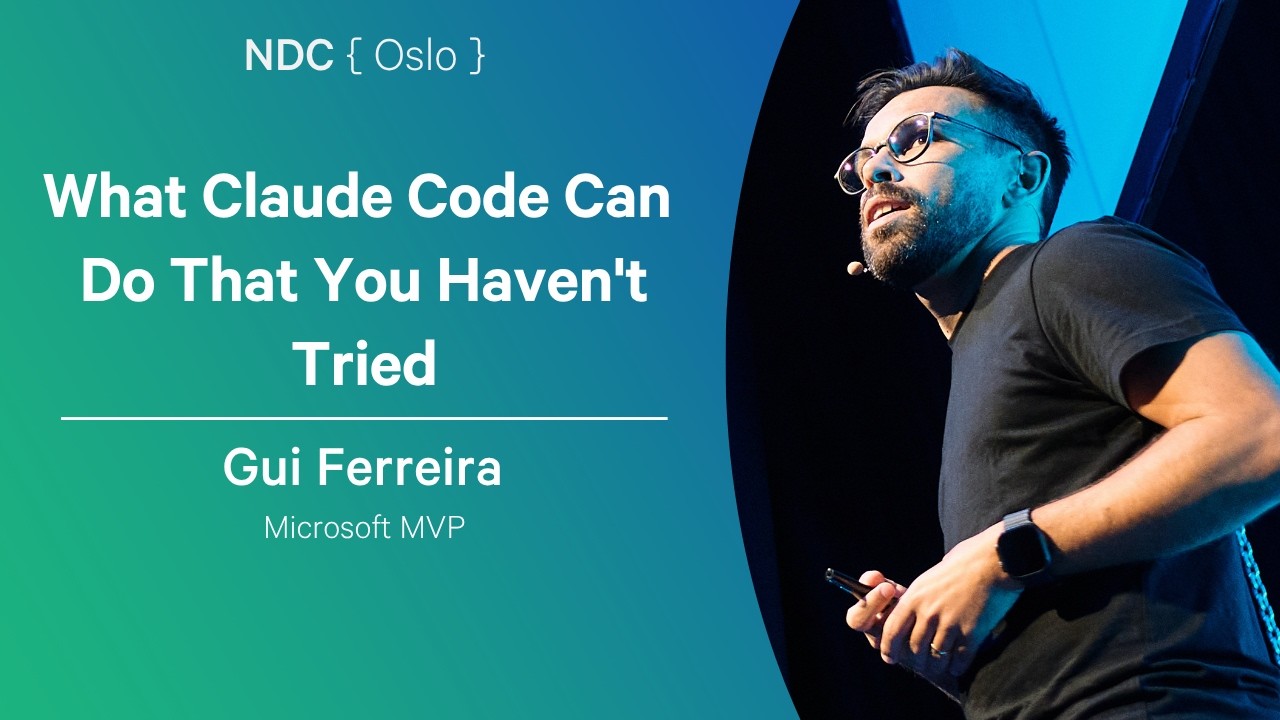
A rapid-fire tour of roughly 40 Claude Code features the speaker uses daily, organized into one-time setup, daily workflow, platform extensions (hooks, skills, MCP), and non-coding uses. Core themes: keep CLAUDE.md lean because long ones measurably hurt quality and cost, actively manage the context window, and push deterministic work out of the model into hooks, skills, and bash commands. He closes with personal examples — organizing a 1,600-file downloads folder, running Claude inside an Obsidian vault, and generating weekly running plans from Strava data.
- An ETH Zurich study found that long, descriptive CLAUDE.md / AGENTS.md files dropped performance by about 3% while increasing cost by about 20%; lean files beat exhaustive ones, and `/doctor` now audits a project's CLAUDE.md for duplication and content that belongs in skills.
- Three questions to prune CLAUDE.md: is this needed for every task, is it rare enough to become a skill or a .claude/rules file, and could the agent figure it out on its own (folder structure descriptions drift from reality and cause errors).
- Use CLAUDE.local.md (gitignored) for personal preferences and the user-profile ~/.claude for cross-project instructions, so team files stay clean; add a permissions deny list in settings.json so Claude never reads secrets or env files while debugging.
- Context management matters: run /context on an empty session to see what skills and config already consume tokens, treat ~40% usage as a quality danger zone, compact proactively at natural checkpoints rather than waiting for auto-compaction, and audit /memory since agents silently record wrong preferences.
- Workflow shortcuts most users miss: Ctrl+G edits the generated plan as a markdown file like a shared doc, double-Escape or /rewind removes bad branches from context instead of prompting a refactor, Ctrl+S stashes a half-written prompt, /btw answers side questions without polluting context, and ultrathink raises effort for a single prompt.
- Hooks beat instructions: a post-tool-use hook that runs tests or a linter costs no tokens and always fires, whereas writing 'always run the tests' in CLAUDE.md requires the model to reason about it and may be skipped.
- Skills are folders, not just a SKILL.md — they can package Python or PowerShell scripts and docs, turning a team's Confluence page of fix scripts into callable capabilities; Anthropic also ships built-in skills like /patch (parallelized large refactors), /simplify, and /loop.
- Non-code uses include generating quarterly self-review summaries from project history, sorting a 1,626-item downloads folder into triage-able categories, and a two-skill setup that pulls Strava runs into Obsidian and plans a sustainable weekly running program.
It overturns the common advice to document everything, with a study and three concrete pruning questions you can apply immediately.
ETH Zurich proved that the performance when you have a long and descriptive CLAUDE.md tends to drop in 3% and your costs will increase in 20%... a good CLAUDE.md, one that is efficient, is actually one that is lean enough.
A sharp explanation of when to move work out of the prompt and into deterministic automation, with both a reliability and a cost argument.
Running this bash command yourself doesn't cost anything in terms of tokens. But if you decide to go to your CLAUDE.md and write 'always run the tests by the end'... actually it's Claude that needs to take the decision, that needs to reason about that, and sometimes won't do it.
If you write it once, eventually it will drift from the reality, so it can lead to problems.
It's like taking one step back to then take two steps forward.
If I couldn't tell you anything new, /insights will tell you a lot about the way that you use Claude.

Nobody Agrees About Agentic Development
A panel at Convex's conference (Jamie Cowling moderating Theo Browne, Jean-Denis Greze of Town, and David Cramer of Sentry) argues about how much agentic coding actually changes software engineering. Theo takes the maximalist position — he runs a two-person team merging 100+ PRs in 24 hours on T3 Code and says throwing away code and docs is now free — while Cramer insists the fundamentals haven't moved and agents mostly amplify the ownership and craft a person already has. Jean-Denis lands in the middle: agents collapse what used to be moats (he cites Plaid's bank integrations) and change what counts as good architecture, but they still break abstractions and create drift that gets expensive. They close on moats (distribution, owning the user), open source in an AI world, and advice to young engineers: be curious, don't start a company, go work with people who know what they're doing.
- Cramer says Sentry's gains from AI are mostly internal — faster access to information, more self-sufficiency — but production hasn't changed: more code gets shipped, much of it has no users, and the bug landscape looks the same.
- Jean-Denis argues agents move where value lives, not just how fast you move: at Plaid, bank integrations required great engineers and were the company's moat; at Town the same work is fully agentic because the contract is easy to define.
- The panel splits hard on architecture — Theo says agents make it dramatically easier to learn systems design because you can load-test three architectures in two days, while Cramer says design comes from iteration and held context that agents can't maintain, so you just compound glue and duct tape.
- Everyone agrees code review was never a good bug-catching mechanism; the better response to 10x more code is building systems that make failures cheap and catchable, not 10x more review time.
- Theo claims agents remove emotional attachment to artifacts: he kills roughly five PRs for every one he lands, no longer 'guilt merges,' and discards most of the ~150 docs he generates daily.
- Jean-Denis reframes architecture quality as 'architecture that lets the LLM meet your product requirements without much human intervention' rather than architecture optimized for human readers.
- Nobody on the panel knows where the moats are in an AI world; they converge on distribution and owning the user, with Jean-Denis warning that LLM products pass through token costs and don't carry the 70-80% margins of classic SaaS.
- On open source, Theo argues the AI-specific risks (easy cloning, easier exploit-finding in exposed backends) are temporary and will hit closed source too, while the benefits — thousands of eyes on the code, agents preferring software they can read and modify — are permanent.
- Cramer's closing advice: don't start a company early in your career, go work with people who know what they're doing, and show craft — he's hired people with terrible resumes based on the care in their personal open source projects.
The sharpest disagreement on the panel — Theo says architectural skill is way easier to develop now, Cramer immediately disagrees and explains why agents only design well in isolation.
Here's the fundamental problem with LLMs is everybody has ADD... software design comes through iteration. It comes from like building a thing and rebuilding a thing and rebuilding a thing, and it's all this subjective stuff... And agents just can't do that well.
A concrete operational claim with numbers behind the abstract 'agents make you faster' argument, plus the reframe from reviewing more to engineering cheaper failures.
Your solution to 10x the engineers isn't going to be 10x the time reviewing. It should be you building systems to make it so failures are cheaper... We merged over a hundred in the last 24 hours and had no major regressions.
At what point would you actually stop reading the code? ... Because if you don't set a bar right now, you're going to keep moving it.
Good architecture is not good architecture for humans anymore. Good architecture is good architecture that allows the LLM to meet your product requirements without needing that much human intervention.
Agents aren't curious. They do what they're told. You're the curiosity.
It is very easy for everybody in this room to go prompt a bunch of stuff together. It is very easy for me to one-up you in every single way by just putting the time in.