Monday, 9 November 2026

Joe Maddalone argues that software engineering's inherited metaphors — the desktop, the file cabinet, the developer-as-craftsman — were design decisions made to accommodate human limits, and AI is changing the economics that justified them. He claims senior engineers are the worst-positioned to exploit AI because they use it as a fast autocomplete for patterns they already know, while newcomers without 40 years of dogma will invent the new workflows. He then attacks the "agentic software factory" idea, borrowing arguments from Rob West's article that assembly lines assume design is already solved and are built to eliminate the variation that design engineering actually needs.
- Metaphors like the desktop, folders, and the floppy-disk save icon outlived the things they represented, and habits built on them get mistaken for fundamental properties of computing rather than 1970s–80s design decisions.
- Many software best practices — DRY, careful abstraction, hand-polished clean code — exist because humans had to type and read every character; if AI can rewrite 500 lines of boilerplate in seconds, the cost of duplication and abstraction changes.
- He reframes the engineer's role from woodworker to urban planner: setting boundaries, enforcing constraints, and directing growth rather than perfecting individual components — what he calls design engineering.
- Directory trees are a crutch invented to compensate for human short-term memory; LLMs and vector databases evaluate code semantically and don't care where a helper function sits in the folder hierarchy.
- The popular claim that AI coding tools only help senior developers is "a trap" — seniors use AI to execute faster on the same architectures they've written since 2008 instead of reimagining the work.
- The next era will come from people who aren't emotionally attached to DRY or traditional refactoring and don't have to spend energy unlearning decades of dogma.
- CI/CD succeeded as an assembly line, but extending that to the entire development lifecycle fails because a ticket is not a blueprint, specifications evolve as you build, and variation is a feature of design work, not a defect.
- Feeding a factory creates pressure to formalize requirements before the problem is understood, and agents will confidently fill the ambiguity with wrong guesses.
- He opens with Marvin Minsky's skepticism of neural networks as the cautionary example of a brilliant person who couldn't imagine a future outside his mental model.
The clearest statement of his central reframing, with a concrete argument about why AI changes the cost of duplication and abstraction.
Suddenly spending three hours hand-polishing your pristine hypermodule class hierarchy isn't craft. It's nostalgia. We aren't woodworkers anymore. We're more akin to urban planners.
This is the video's most contrarian claim and the one that gives it its title.
When a seasoned developer uses AI, they tend to use it as a hyper-efficient autocomplete for their own mental models. They write the exact same design patterns and architectures they've been writing since 2008, only faster.
If you are still treating software development like you're hand carving a piece of wood, you are focused on a bench while the city around you burns.
A ticket is not a blueprint.
We're applying a 19th-century industrial mental model to a 21st-century cognitive shift... We're going to use groundbreaking technology to just do the wrong things faster.

A walkthrough of PR Agent, an open-source AI code reviewer (formerly a commercial product, now donated to the community, ~13k GitHub stars) that describes, reviews, and improves pull requests. The host sets it up as a GitHub Action with an OpenAI key and GitHub token, then tunes it with a .pr_agent.toml file to get committable code suggestions, dynamic context expansion, and self-reflection scoring. His verdict: it replaces the lazy "review this PR thoroughly" prompt he'd been using, and it's good enough to take over his private projects, though it still lacks CodeRabbit's one-click apply-all-suggestions button.
- PR Agent lives under its own GitHub org, was previously a paid product that big companies used, and was contributed to the community in full — so it can be self-hosted and pointed at any LLM, your own subscription, or a local model.
- It works with GitHub, GitLab, Bitbucket, and Azure DevOps, and the command names mirror what it does: describe, review, improve.
- For oversized PRs it runs token-aware compression in a set order — deleted files first, then hunks and patches, dropping images, packages, and binaries — before anything hits the model; model, size, fallback models, timeouts, and token limits are all configurable.
- Setup is a GitHub Action: drop a pr_agent YAML under .github/workflows, add an OpenAI key secret, and the GitHub token is picked up automatically; the action pulls the prebuilt image from Docker Hub.
- Default output includes a human-oriented "review effort" score, a review guide, and collapsed code suggestions tagged by impact.
- To get suggestions you can apply straight from the PR discussion, set committable code suggestions to true — either as a manual trigger flag or, better, in a .pr_agent.toml config file.
- The host lost roughly an hour because he named the config file PR_agent_toml instead of .pr_agent.toml, and it silently failed to load.
- Extra features: pluggable skills (e.g. Terraform review guidance) that can be scoped to paths and token-capped, dynamic context that expands code around the diff so the model understands it, and a self-reflection step where the agent scores its own output.
- The one missing piece versus CodeRabbit (the channel's sponsor, which the host pays for at work) is an "approve all changes" checkbox to apply every suggestion at once.
The clearest explanation of the mechanism that makes the tool practical on large, AI-generated diffs.
If the PR is small enough, no problems. If it's too large, as AI changes tend to get, it'll start compressing, starting with deleted files, onto hunks and patches, ditch images, compressed packages and binaries, and basically running through a cleanup before it hits your token-consuming machine.
The one config change that closes the gap with paid tools, plus the exact gotcha most people will hit.
I called this file PR underscore agent underscore toml and could not figure out why it won't work for the better part of the next hour. Draw your own conclusions.
This is the code prompt I added, basically saying, 'Review the changes in this pull request thoroughly.' Well done, mate. You nailed it.
The PR agent interacts with GitHub, GitLab, and Bitbucket if you took a wrong turn in life, even Azure DevOps if it was more than one turn.
PR agent is not the only option in the open source space, not even the popular one if you count stars alone, but it's the one I currently trust.
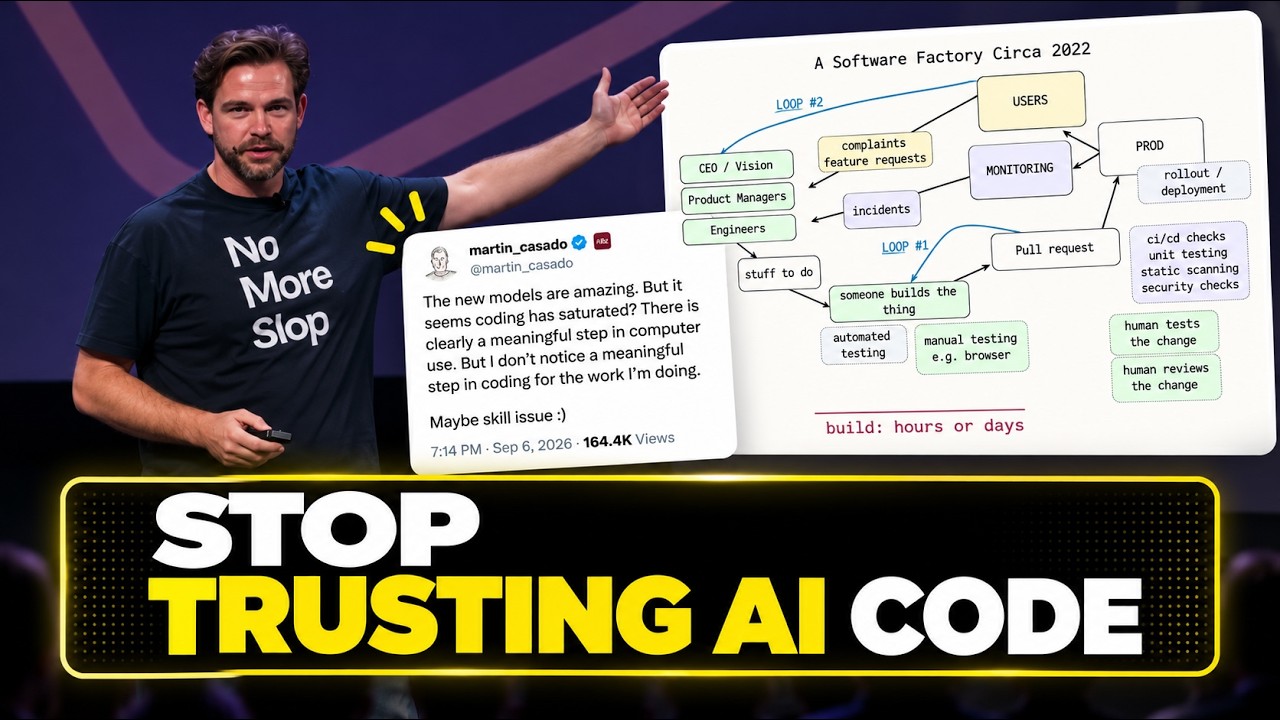
Dex, co-founder of Human Layer, gives a 10-minute conference talk arguing that the "lights-out software factory" — merging agent-written code without human review — doesn't work yet, because models still can't maintain or improve codebase quality over time. He backs this with SlopCodeBench, a University of Wisconsin benchmark that reveals the problem by drip-feeding requirements instead of stating them up front, where the then-best model scored 14.8%. The rest of the talk is a set of ~9 practices (he jokingly calls them "12-factor factories") for running agentic development with humans still in the loop, plus a sketch of the tooling layers teams need to buy or build.
- Agentic coding compressed the build step from hours/days to minutes/hours, but review stayed slow, so review is now the bottleneck — which tempts teams into skipping it entirely.
- Data he cites shows code review quality falling since teams adopted current-generation models: PRs skipping review, more and longer comments, incidents per PR up, bugs per developer up — and he argues this isn't just a skill issue.
- Core thesis: unattended models will not improve or maintain codebase quality over time; you can tell them to improve it, but only if you understand the code, which means it isn't unattended.
- Maintainability has no fast oracle, so reinforcement learning can't reward it — bad architecture shows up months later, while RL incentivizes just getting tests to pass.
- SlopCodeBench discloses a problem in pieces and forces iterative feature additions, mirroring real development; GPT-5.5 scored 14.8% on it even while terminal-style benchmarks sit near 95%, and newer models only improved by about a percentage point.
- Steve Yegge, who spent a year telling people that reading the code would leave them behind, has publicly reversed: unattended models write slop and build systems too complex for themselves to debug.
- Recommended practices: plan 20-30 minutes before building (but don't overplan — think in terms of expected pain), make agents show you work visually instead of walls of prose, give agents browsers/curl/video so they can test and get back pressure, use anti-slop lint rules, and pipe user feedback and pager alerts in with a candidate PR attached.
- He frames the agentic tooling stack as four buy-or-build layers — compute, dev environment, harness, and control plane — and positions Human Layer in the control plane as a shared workspace that streams diffs to the cloud so review can happen before a pull request exists.
It's the mechanistic explanation behind the talk's central claim, immediately paired with the 14.8% SlopCodeBench result that contrasts with near-saturated coding benchmarks.
To do reinforcement learning, you need an oracle. You need a verifier. You need something to say, 'Is this code maintainable or not?' And maintainability has no fast oracle. We don't find out that the code was ugly until two months later when someone is paged at 3:00 in the morning trying to figure out how this made it into the codebase.
A concrete, named reversal by a prominent advocate, followed by the actual model-over-model improvement numbers that undercut the hype.
He went around the internet telling people for a year that if you're still trying to read the code, you are going to fall behind... and here he is last week: if you don't pay attention to the models, they're going to write slop code. They're going to build something so complex that they themselves can't debug it.
Unattended models will not improve or maintain your codebase quality over time.
Maintainability has no fast oracle.
You would say, 'The code is slop, but that'll be GPT-7's problem.' Folks, we're at GPT-6, and I don't think we've gotten that much better at this.
Planning is about eliminating expected pain.
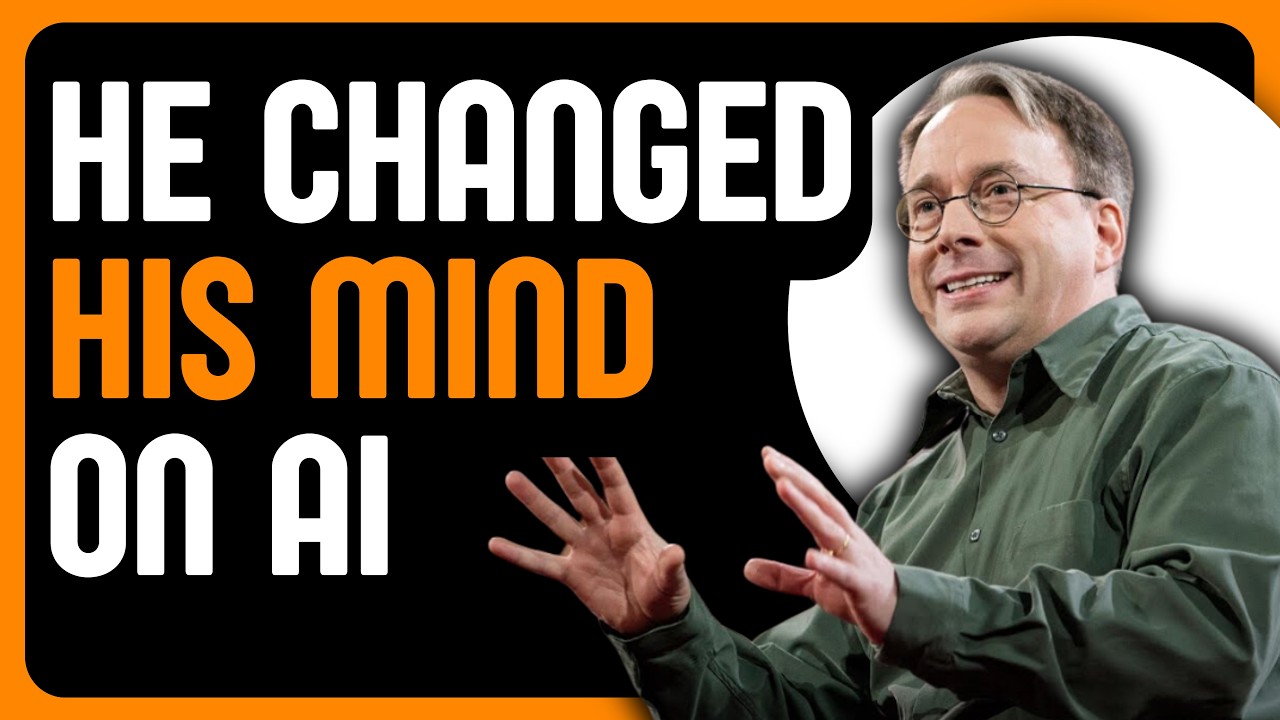
SavvyNik recaps a Linux Foundation stage conversation between Linus Torvalds and Dirk Hohndel at Open Source Summit Europe, focused on how AI is already reshaping kernel work. Linus says AI review bots (the Google-maintained one he calls Sashiko) have become near-mandatory in some subsystems, creating a situation where an AI flood of patches is being met with an AI flood of reviews — useful overall, but a real source of maintainer stress. He also describes his own shift from dismissing AI to using it happily on hobby projects, and argues vibe coding is a good 'gateway drug' into programming while still being risky for serious work.
- AI patch-review bots now run publicly on kernel mailing lists, and some subsystems won't accept patches unless they've been reviewed by the Google-maintained tool first.
- Linus admits AI reviews are often wrong, but shrugs that human reviews are often wrong too.
- The kernel is getting a deluge of AI-generated patches — some catching real security bugs, some fixing code nobody has touched in 20 years — and maintainers are fighting that deluge with their own AI review tooling.
- Three quarters of the discussion at the preceding maintainer summit was about making AI code generation and review less stressful and more useful, which Linus calls a problem for maintainers.
- Linus describes his own arc: he used to think AI was just not very good, then interesting, and now he genuinely enjoys using it — though mostly on toy projects, since he works as a maintainer and technical lead rather than writing much kernel code.
- He argues the bar in software engineering has gotten so high that beginners can't see their own work as worthwhile, and AI lowers that bar enough to let people find joy in programming.
- He still 'poo-poos' vibe coding for real, important projects — the value is as a gateway into programming, and you eventually need to understand the code.
- On his guitar-pedal project, his first AI prompt for a JavaScript UI produced something 'horrendous'; it only worked once he told the AI to reproduce the C implementation he had already written correctly and just give it a pretty face.
- The intro notes Linus previously credited AI with doing the tedious investigation in a 'debug session from hell' — a memory management bug in an Intel GPU driver that booted Linux to a black screen — even after the AI itself suggested giving up.
Linus describes the strangest second-order effect of AI in open source: automated patches being answered by automated reviews, with real maintainer cost attached.
We are to some degree fighting the AI deluge of patches with our own AI deluge of patch review. And people are jokingly saying that there are bots talking to bots, and it does actually happen.
This is the reversal the video is built around — Linus endorsing vibe coding as a way for beginners to find joy, while holding the line on serious code.
I used to poo-poo AI, and I used to poo-poo vibe coding. And I still do for real projects... But I love the concept of AI as a gateway drug into programming.
Some of the complaints that AI sometimes gives in reviews are just wrong. That's reality, and I wouldn't even blame AI for that because some of the reviews that people give are just wrong.
I don't do Java. I don't do all those fancy things. I do kernels. I do manly things. I do low-level programming in C.
I gave it a prompt, and it did it, and it was horrendous.

A developer with 10 years of experience argues that AI coding agents have, in the span of months, changed software engineering from hands-on construction into supervising machines. His specific worry isn't job loss but that the exact skill he spent a decade building — deep, patient debugging of complicated systems — is one of the things agents do best, and that the most productive way to work now bears little resemblance to the craft that drew people into the field. He frames the shift as going from craftsman to factory floor manager, and points to a friend, one of the best engineers he knows, who was laid off and has decided not to return.
- The change is recent and fast — he says anything written about AI coding before May 2026 should be treated as outdated, since tools moved from autocomplete-style assistants to agents that explore codebases, run tests, and iterate on their own work.
- His personal edge was going five or six layers deep to find root causes others missed, and that is precisely the kind of tireless search-and-trace work agents are now good at.
- Experience still matters for evaluating output, spotting mistakes, and directing agents, but its value has shifted rather than remained intact.
- The 'mechanical joy' of building something you fully understand is hard to justify commercially when an agent can produce the same feature far faster — you can still code by hand, but as a hobby, not as a career.
- Many excellent engineers are motivated by the engineering itself rather than product or business outcomes (the Steve Wozniak archetype), and the standard advice to become product-focused asks them to do a job they never wanted.
- He rejects the power-tools analogy: an electric planer still leaves the carpenter making the furniture, while agentic development is closer to replacing the workshop with an automated factory you inspect and shout at.
- He doesn't predict outcomes — cheaper software might create huge new demand, but he won't assume it will or that the new work needs the same skills.
- Both reactions are reasonable in his view: for product-lovers this is the most exciting moment in history; for craft-lovers the career feels like it's disappearing.
The sharpest version of his argument — the decade-long skill he built is the one agents are best suited to replace.
If the thing that made you particularly valuable was your ability to solve problems when other people couldn't, what happens when everybody has access to solving those problems?
A direct rebuttal to the most common analogy used to downplay AI's impact on programming.
What we're experiencing is closer to replacing the carpenter's workshop with a fully automated furniture factory... You've gone from being a craftsman to being a factory floor manager, essentially just yelling at the machines.
The most productive way to do the job is becoming less and less like the activity that made people want to do the job in the first place.
He didn't stop loving engineering. The job stopped being the kind of engineering he loved.
If I read something about AI coding that was written before May of 2026, I would absolutely consider that outdated.

AI coding agents are pushing code faster than Git servers can handle, and OpenAI and Anthropic solved it in opposite ways. OpenAI built Pando, a new Git backend that keeps the normal Git client workflow and cut median push latency by nearly 80%. Anthropic built Scion, a full Git replacement where commits, merges and history live on the server, claiming roughly 200x less CPU and memory than its old Git mirroring setup. Neither is available to the public, so the practical advice for everyone else is Git worktrees, sparse checkouts, and tighter CI.
- Anthropic went from roughly 2,500 merged code changes a day to over 30,000 in four months, while OpenAI's monorepo reliability sometimes fell below 90%.
- OpenAI's Pando replaces only the Git backend: it handles updates to different branches immediately and caches Git pack files so repeated CI requests don't regenerate the same data.
- Pando's tradeoff is that reads across multiple branches aren't guaranteed to give one perfectly synchronized view of the repo, but median push latency dropped nearly 80% and it now serves close to a petabyte of Git data daily.
- Pando's core was designed by one engineer, implemented largely by Codex agents, and shipped from kickoff to production in about 10 weeks.
- Anthropic's main branch history was approaching 100 GB with about 25 million CI checkouts a day, mostly from always-connected agents, so it built Scion where clients fetch only the files they need and server-side operations handle commits and merges.
- Scion claims about 200x less CPU and memory than the old Git mirroring infrastructure, checkouts dropping from minutes to seconds, and roughly 25% of CI CPU capacity recovered — but Anthropic had to rebuild code review, code search, and CI tooling around it.
- Neither system is installable today, and the reported gains come from workloads most teams will never approach.
- The practical takeaways: use Git worktrees so each agent works in its own directory and branch, use sparse checkouts on large repos, and tune CI by caching dependencies, avoiding duplicate jobs, and running only relevant tests.
It's the one piece of advice in the video a viewer can act on immediately, demonstrated live with two agents.
If you run both agents in the same folder, you should know they are just editing the same file. So one agent's changes can immediately affect the other... But Git already has a work way around this, right? It's work trees.
Back-to-back breakdown of both architectures and their headline numbers — the core comparison the video promises.
Instead of asking how to make Git scale, Anthropic asked whether it still needed Git at all.
The core was designed by one engineer, implemented largely by Codex agents, and went from kickoff to production in about 10 weeks.
That 200 times improvement doesn't mean Scion is 200 times faster than your Git on your laptop.
Both systems were built with major help from the same AI coding agents that created the problem in the first place.

Dr. K went through 172 questions submitted by developers and found most weren't about relationships or sleep — they were about AI: lost joy in coding, management demanding 3x output, and careers that now consist of reviewing AI-generated code. He admits nobody, including him, knows whether the AI bubble pops or the tools keep improving, so he focuses on the two things he can help with: managing your boss and managing your own head. The core tactic is social jujitsu — match management's excitement about AI rather than contradicting it, then deliver your concerns as data-backed risk analysis (SWOT, documented emails) so you're the AI-savvy person protecting the company rather than the naysayer.
- The submitted questions clustered into three buckets: what AI is actually doing to the industry, how to handle management's AI mandate, and how to cope personally with despair, boredom and burnout.
- Dr. K explicitly says he doesn't know whether the AI bubble will pop, whether circular financing between chip makers and AI labs collapses, or whether models will improve enough to justify the hype — and doubts anyone does.
- He cites the DORA report: for every 25% increase in AI-generated code, stability drops roughly 7.2%, so doubling output implies about a 30% stability decline.
- He cites a paper on pull request review finding an 'intention-effectiveness gap' — visible human review activity does not reliably translate into defect prevention, partly because AI code lacks the documentation and comments that make review meaningful.
- A meta-analysis of 106 experiments found human-AI combinations performed slightly worse than the best of human alone or AI alone, though the data predates frontier LLMs.
- The recommended script: match your boss's emotional energy first, then frame concerns as 'here's how we do AI adoption successfully, unlike the companies making mistakes,' using frameworks like SWOT and documenting everything by email as cover.
- He pushes back on the stereotype that devs are socially inept — the analogy is charisma 15 with no proficiency in persuasion, meaning the raw ability is there but the skill was never trained.
- Explicitly reject the satisfying revenge move (dumping an impossible review task back on an executive) and avoid 'I told you so' — but if management comes hard at you, point to the documented warnings you already delivered.
This is the concrete number and the exact reframe — 'this is a good thing because it accelerates our awareness of bugs' — that turns a complaint into a risk analysis management can accept.
Every 25% of code that is produced, the number of bugs, the stability decreases by 7.2%... So, if I'm doubling my output, the stability of the product is going to drop by about 30%.
A vivid analogy for why 'just review the AI's output' is unworkable, immediately followed by the warning that satisfying payback moves backfire emotionally.
Then you reach into your backpack, you pull out a stack of 300 more pages of Excel spreadsheet. Then I'm going to say, 'Find the mistakes.' This is basically what we're being told to do.
I'm not even sure that a single person on the planet knows how AI is really going to shake out. What I do know is that I don't know and I can't help y'all with that.
Your charisma is like 15. You just don't have proficiency in persuasion.
In a company environment, they're going to kill the messenger. So what you need to do is not serve hard truths. You want to serve protective truths.

A framing of retrieval as a four-level pyramid: no retrieval (long context), keyword/grep search driven by an agent, a vector index inside an existing database, and finally a dedicated vector database. The argument against vector databases rests on agentic keyword search, huge context windows, and embedding costs — all valid until you hit the semantic gap or massive vector counts. The verdict is two questions: do you need vector search at all, and if so, do you need a dedicated system for it. Only climb the pyramid when the workload actually demands it.
- A vector database stores content as embeddings — points in high-dimensional space arranged so similar meanings sit near each other — and returns semantically similar items at retrieval time, commonly for RAG.
- The retrieval pyramid runs from no retrieval at the bottom to a dedicated vector database at the top, and you should only move up when the workload warrants it.
- Agentic search weakens the case for embeddings: an AI agent running grep or keyword search doesn't have to get retrieval right in one shot — it can search, read results, refine, and loop.
- Long context windows (frontier models take roughly a thousand times more text than a few years ago) let you skip retrieval, but token costs rise and context bloat can make the model perform worse than targeted retrieval.
- Embedding costs are real: documents must be chunked and embedded on ingest, every query must be embedded, and switching embedding models means re-embedding everything.
- The semantic gap is the strongest argument for embeddings — a query like "how do I reset my password" shares no words with a ticket titled "credentials loop after update," so grep finds nothing while the two are close neighbors in embedding space.
- Most mainstream databases now support vector search natively, since an embedding is just an extra column of numbers and indexing columns is what databases do — so a vector index often suffices.
- A dedicated vector database earns its place when vectors run into the many millions or billions and must be held in memory and queried in milliseconds, where a general-purpose database starts to strain.
The clearest concrete example of where keyword search fails and embeddings earn their cost.
A user types: how do I reset my password? Now, it turns out that there is already a ticket... called credentials loop after update. Keyword search isn't gonna find this ticket because these two things don't share a single word.
Condenses the whole argument into a decision rule you can apply to your own workload.
The first question is, is vector search still needed? And if the answer to that is yes, then the second question is, is a dedicated vector database still needed?
There's no point scampering to the top for the sake of it and taking an unnecessary fall.
Keyword search, even if it takes a few tries, can be as good as vector search without some of the downsides.
Context bloat can result in an AI model performing worse than retrieving just the relevant sections from a knowledge store when they're needed.

The 0rwx Framework
Tris proposes "0rwx," a four-level vocabulary for describing how much AI went into a piece of work, borrowed from Unix file permissions: 0 = deny (no AI), r = read (AI can advise but not write), w = write (AI makes isolated changes you still check), x = execute (fully agentic, opaque). He argues existing AI-autonomy scales copied from the self-driving car industry are built on a fantasy of full automation, and that at high automation levels people who claim they "read the code" are unreliable narrators of their own process. The point of the labels isn't virtue signaling but having precise language in conversation, with accreditation (research assistant / co-writer / mostly AI-written) as a fallback phrasing.
- The framework came out of uninstalling an Obsidian plugin that turned out to be entirely vibe coded by a writer with no programming background — the problem wasn't the vibe coding itself, it was the lack of labeling.
- Tris's personal standard is stricter than Mitchell Hashimoto's "I read the code": he wants every character he publishes to be written by him, which is the thesis of brainmade.org.
- He rejects AI autonomy scales modeled on the automotive industry's five driverless levels, because cars have been stuck at level two for a decade and the higher levels are fantasy.
- Lisanne Bainbridge's 1983 paper "Ironies of Automation" explains the core risk: near-total automation makes the human complacent, atrophies their skills, and leaves them unprepared for the rare moment intervention is needed.
- Near-perfect automation changes the operator's job from being expert at the task to being expert at monitoring the machine — which requires different training, like the Japanese rail practice of shisa kanko (pointing and calling), credited with reducing errors by up to 85%.
- The four 0rwx levels are distinguished not by which tool you use but by your ability to scrutinize the generated work.
- Managers and CEOs are novices in Adam Savage's sense — they don't know when tight or loose tolerances are needed — so they assume AI is fine everywhere; professionals know which corners can be cut, but only if the cutting is stated plainly.
- Icons are available at 0rwx.com, but Tris frames them as a conversational clarity tool rather than a farm-to-table purity badge; if the labels don't fit, use credits instead — AI research assistant, co-writer, or just own it.
The 1983 automation research lands directly on today's agentic coding debate and delivers the video's sharpest claim.
At high levels of AI automation, like with Claude code, I think people who say they read the code are lying to themselves. They can't. Not anymore, anyway. They have become an unreliable narrator of their own experience.
This is the framework itself, stated compactly, including the key clarification that the levels are about scrutiny rather than tooling.
Level zero is deny. AI has no access to your work... Level one is read-only permissions... Level two is write permissions... And the final level is execute permissions. Fully agentic, it builds your work opaquely.
Making a car kickflip is easy. Ensuring it never kills a skateboarder in the street is not.
When automation becomes close to perfect, the operator skill set switches from being expert at the task to being expert at monitoring the machine doing the task.
Professionals know when the corners can be cut, but only if we know the corners are being cut, and that requires clear language.
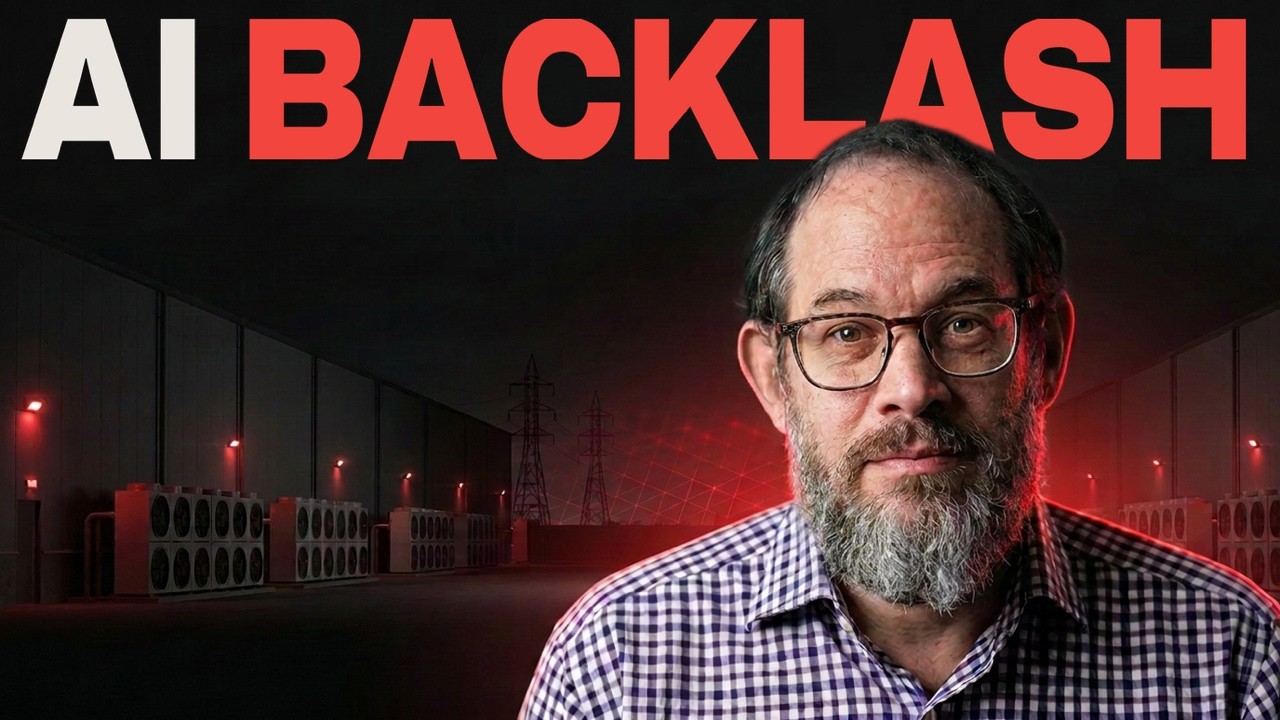
Nate Jones argues that the November 3, 2026 election was a rout for data center development even as AI usage keeps climbing, and he walks through the second- and third-order effects of constraining compute supply. Delays and permitting fights will likely kill smaller neoclouds while strengthening incumbents who already have operating capacity, and they may ironically reduce the odds of an overbuild bubble by letting demand catch up to supply. Projects that can't get sited in the US will move abroad or, eventually, into orbit — and he thinks the election pulled orbital compute forward from roughly ten years out to six to eight. He closes by blaming Silicon Valley's own messaging for making AI feel like it's working against ordinary people.
- Polling shows the contradiction clearly: 65% of American adults used an AI chatbot in the prior week (Edison Research/SSRS, May, up from 52% in February), while 72% opposed a new data center in their community (ABC/Post/Ipsos, October).
- Local votes backed data center restrictions by lopsided margins — in Edgewater, Florida, more than three quarters of voters supported a prohibition, which Jones says was typical nationwide.
- Demand is not slowing: Google reported model API usage up 40% quarter over quarter and more than 4x year over year, and said it had started buying outside compute because of Google Cloud supply constraints.
- Neoclouds that built plans around cheap, fast, low-regulation Texas sites are most exposed — debt, depreciation, and signed delivery dates keep running while approvals and power connections slip, which can kill a company that still has plenty of customers.
- Failed projects get bought cheaply by cash-rich incumbents, and scarcity of new capacity raises utilization and pricing for existing data centers, so a public political defeat for AI may end up concentrating the industry around big tech.
- Citing Derek Thompson, Jones argues slowing supply gives demand time to catch up, lowering the risk of a 2027-2028 capacity glut even as it bankrupts individual developers.
- Communities that stay welcoming gain real bargaining power over infrastructure costs, union jobs, and local investment, since developers will pay more for a site that can actually open on schedule.
- Displaced investment will go to Canada, Mexico, India, Southeast Asia and South America rather than the EU, which isn't seen as faster to build in — meaning communities that block data centers end up renting the technology instead of owning the jobs and spending.
The core counterintuitive claim of the video: a populist vote against data centers hands incumbents cheaper assets, better pricing power, and more leverage over the startups competing with them.
The company that fails doesn't necessarily take the project with it because AI demand keeps rising. Someone else is going to buy that project... So the backlash against the AI build out may end up, ironically, strengthening big tech.
A specific, falsifiable forecast shift, with the reasoning — regulatory arbitrage in orbit — laid out alongside the real hardware obstacles.
If I were a betting person, my bet would go from 10 years to maybe six to eight because this election creates enough uncertainty around compute in the US that you'd rather have an option in orbit.
People are out there mocking us and talking about how this is a victory for ordinary people versus people who want AI to make humans extinct. You're not winning if you're talking about making humans extinct.
If you keep a data center out of the community, it doesn't keep the technology out. It just means you're renting the technology and you don't own it.
I had a note after the midterms from a friend of mine who's in tech and he feels left out of the AI race. And get this, he's at an AI company and he doesn't feel caught up.