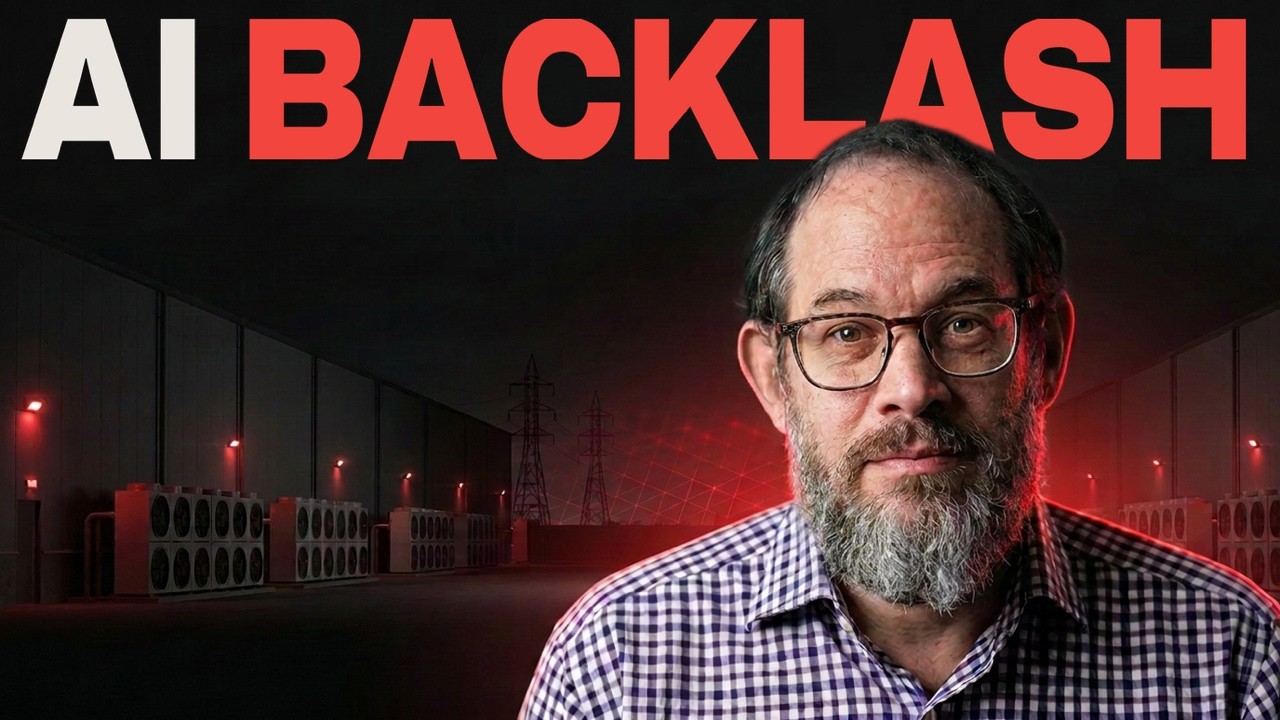
Nate Jones argues that the November 3, 2026 election was a rout for data center development even as AI usage keeps climbing, and he walks through the second- and third-order effects of constraining compute supply. Delays and permitting fights will likely kill smaller neoclouds while strengthening incumbents who already have operating capacity, and they may ironically reduce the odds of an overbuild bubble by letting demand catch up to supply. Projects that can't get sited in the US will move abroad or, eventually, into orbit — and he thinks the election pulled orbital compute forward from roughly ten years out to six to eight. He closes by blaming Silicon Valley's own messaging for making AI feel like it's working against ordinary people.
- Polling shows the contradiction clearly: 65% of American adults used an AI chatbot in the prior week (Edison Research/SSRS, May, up from 52% in February), while 72% opposed a new data center in their community (ABC/Post/Ipsos, October).
- Local votes backed data center restrictions by lopsided margins — in Edgewater, Florida, more than three quarters of voters supported a prohibition, which Jones says was typical nationwide.
- Demand is not slowing: Google reported model API usage up 40% quarter over quarter and more than 4x year over year, and said it had started buying outside compute because of Google Cloud supply constraints.
- Neoclouds that built plans around cheap, fast, low-regulation Texas sites are most exposed — debt, depreciation, and signed delivery dates keep running while approvals and power connections slip, which can kill a company that still has plenty of customers.
- Failed projects get bought cheaply by cash-rich incumbents, and scarcity of new capacity raises utilization and pricing for existing data centers, so a public political defeat for AI may end up concentrating the industry around big tech.
- Citing Derek Thompson, Jones argues slowing supply gives demand time to catch up, lowering the risk of a 2027-2028 capacity glut even as it bankrupts individual developers.
- Communities that stay welcoming gain real bargaining power over infrastructure costs, union jobs, and local investment, since developers will pay more for a site that can actually open on schedule.
- Displaced investment will go to Canada, Mexico, India, Southeast Asia and South America rather than the EU, which isn't seen as faster to build in — meaning communities that block data centers end up renting the technology instead of owning the jobs and spending.
The core counterintuitive claim of the video: a populist vote against data centers hands incumbents cheaper assets, better pricing power, and more leverage over the startups competing with them.
The company that fails doesn't necessarily take the project with it because AI demand keeps rising. Someone else is going to buy that project... So the backlash against the AI build out may end up, ironically, strengthening big tech.
A specific, falsifiable forecast shift, with the reasoning — regulatory arbitrage in orbit — laid out alongside the real hardware obstacles.
If I were a betting person, my bet would go from 10 years to maybe six to eight because this election creates enough uncertainty around compute in the US that you'd rather have an option in orbit.
People are out there mocking us and talking about how this is a victory for ordinary people versus people who want AI to make humans extinct. You're not winning if you're talking about making humans extinct.
If you keep a data center out of the community, it doesn't keep the technology out. It just means you're renting the technology and you don't own it.
I had a note after the midterms from a friend of mine who's in tech and he feels left out of the AI race. And get this, he's at an AI company and he doesn't feel caught up.