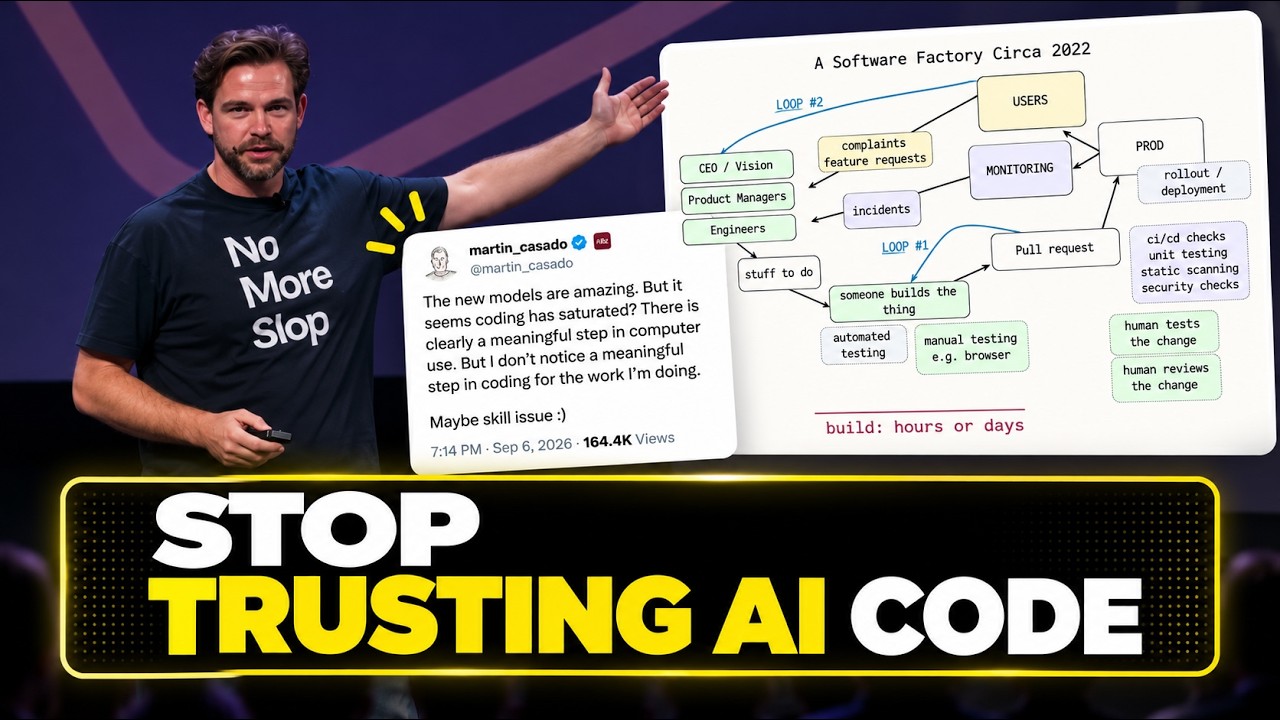
Dex, co-founder of Human Layer, gives a 10-minute conference talk arguing that the "lights-out software factory" — merging agent-written code without human review — doesn't work yet, because models still can't maintain or improve codebase quality over time. He backs this with SlopCodeBench, a University of Wisconsin benchmark that reveals the problem by drip-feeding requirements instead of stating them up front, where the then-best model scored 14.8%. The rest of the talk is a set of ~9 practices (he jokingly calls them "12-factor factories") for running agentic development with humans still in the loop, plus a sketch of the tooling layers teams need to buy or build.
- Agentic coding compressed the build step from hours/days to minutes/hours, but review stayed slow, so review is now the bottleneck — which tempts teams into skipping it entirely.
- Data he cites shows code review quality falling since teams adopted current-generation models: PRs skipping review, more and longer comments, incidents per PR up, bugs per developer up — and he argues this isn't just a skill issue.
- Core thesis: unattended models will not improve or maintain codebase quality over time; you can tell them to improve it, but only if you understand the code, which means it isn't unattended.
- Maintainability has no fast oracle, so reinforcement learning can't reward it — bad architecture shows up months later, while RL incentivizes just getting tests to pass.
- SlopCodeBench discloses a problem in pieces and forces iterative feature additions, mirroring real development; GPT-5.5 scored 14.8% on it even while terminal-style benchmarks sit near 95%, and newer models only improved by about a percentage point.
- Steve Yegge, who spent a year telling people that reading the code would leave them behind, has publicly reversed: unattended models write slop and build systems too complex for themselves to debug.
- Recommended practices: plan 20-30 minutes before building (but don't overplan — think in terms of expected pain), make agents show you work visually instead of walls of prose, give agents browsers/curl/video so they can test and get back pressure, use anti-slop lint rules, and pipe user feedback and pager alerts in with a candidate PR attached.
- He frames the agentic tooling stack as four buy-or-build layers — compute, dev environment, harness, and control plane — and positions Human Layer in the control plane as a shared workspace that streams diffs to the cloud so review can happen before a pull request exists.
It's the mechanistic explanation behind the talk's central claim, immediately paired with the 14.8% SlopCodeBench result that contrasts with near-saturated coding benchmarks.
To do reinforcement learning, you need an oracle. You need a verifier. You need something to say, 'Is this code maintainable or not?' And maintainability has no fast oracle. We don't find out that the code was ugly until two months later when someone is paged at 3:00 in the morning trying to figure out how this made it into the codebase.
A concrete, named reversal by a prominent advocate, followed by the actual model-over-model improvement numbers that undercut the hype.
He went around the internet telling people for a year that if you're still trying to read the code, you are going to fall behind... and here he is last week: if you don't pay attention to the models, they're going to write slop code. They're going to build something so complex that they themselves can't debug it.
Unattended models will not improve or maintain your codebase quality over time.
Maintainability has no fast oracle.
You would say, 'The code is slop, but that'll be GPT-7's problem.' Folks, we're at GPT-6, and I don't think we've gotten that much better at this.
Planning is about eliminating expected pain.